Gary D. Joiner
The Castle Hotel is significant in the Civil Rights Movement both locally and nationally. The hotel, located at 1000 Sprague Street, began during World War I. It was managed for thirty years by Cora Snowden. When she died in 1949, she had no direct heirs, but left a substantial legacy to ten nieces and nephews. The Castle was located at the corner of Sprague Street and Baker Street. During the late 1950s and 1960s, it served as a place where Civil Rights Movement leaders stayed without incurring publicity. The most prominent of these leaders was Reverend Martin Luther King, Jr., who stayed there on multiple occasions over several years. Reverend King met with local pastors and organizers to advance voting rights, school desegregation, lunch counter desegregation, and local trolley and bus desegregation.
In Figure 32 below, the Castle Hotel is on the right at 1000 Sprague Street. The view is from the northernmost point of Oakland Cemetery, known as the Hebrew Gate. The building to the left of the hotel is the dental office of Dr. Elbert E. Allen. Dr. Allen also rented out rooms in his two-story building. He was also influential in the Civil Rights Movement locally.
The Castle Hotel was ideally located. It was in the shadow of downtown but located almost on the eastern edge of St. Paul’s Bottoms. Organizers could stay at the hotel, but work with community leaders at nearby churches on Texas Avenue and Milam Street. Milam was most active street in Shreveport for Civil Rights activities during the 1950s and 1960s.
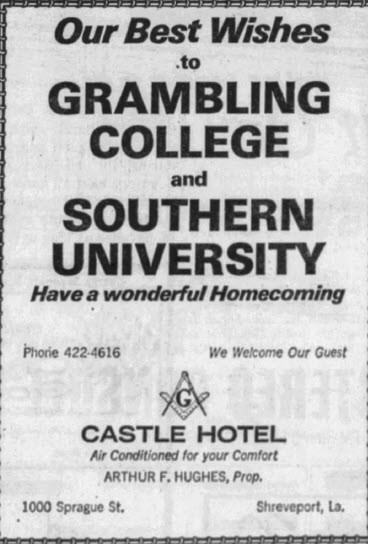
Following Cora Snowden’s death, the Castle Hotel was owned and managed by a succession of others including Simon Banks, William Carthrum, Arthur Hughes, and George Smith. In the last decade of its existence, it also was the location, on the first floor, of Castle Package Liquor.
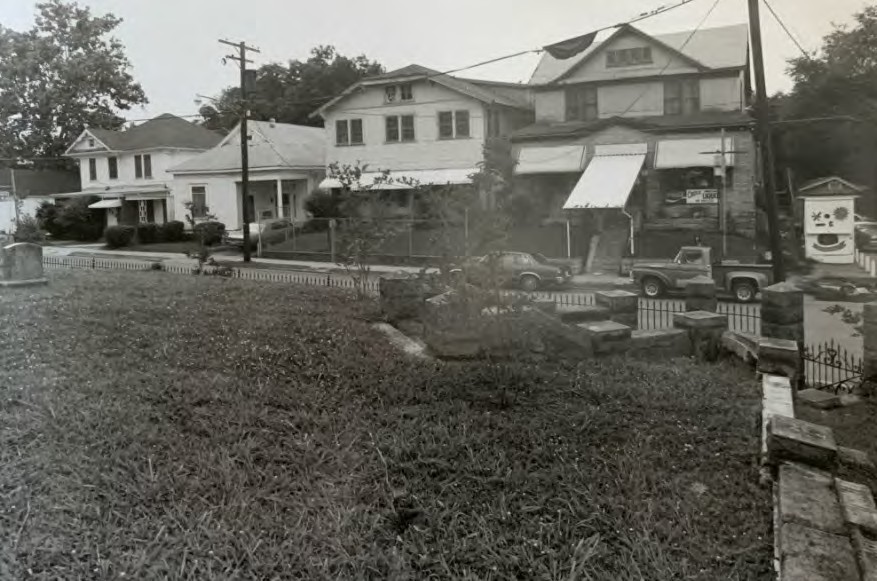
Louisiana State University in Shreveport. Image P85.
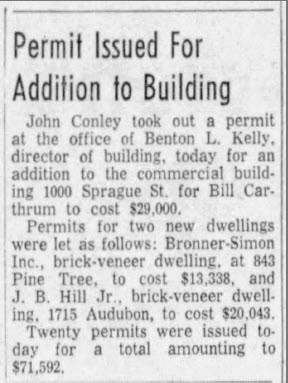
In Figure 33 above, the Castle Hotel had enough business om 1959 to request a construction permit to add two additional rental rooms. These filled out space on the second story.
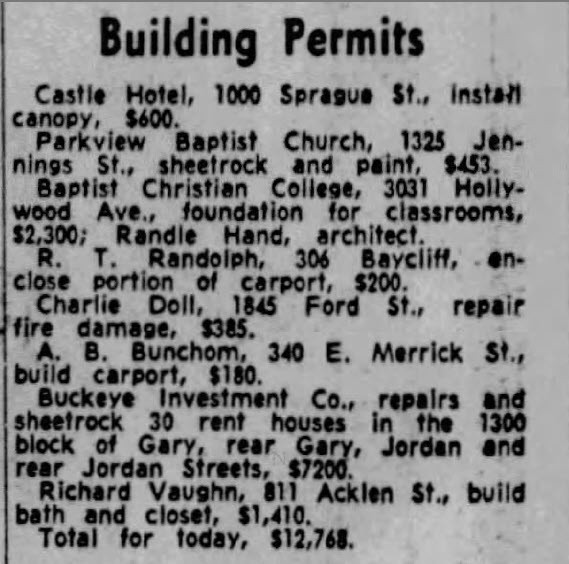
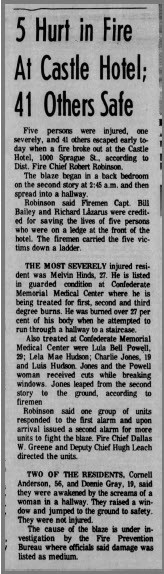
The Castle Hotel suffered a devastating fire in August 1975. The blaze began at the rear of the second story. Five people were injured, but forty-one escaped unharmed.
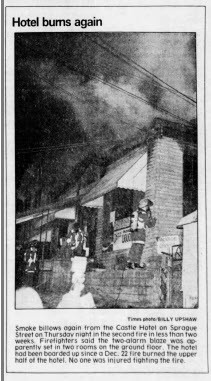
On December 22, 1989, The Castle Hotel suffered a catastrophic fire on its upper story. Less than two weeks later, the boarded up structure was hit by arson again. Fire investigators determined that both blazes were arson and that two separate fires had been set on the first floor on the January 4, 1990 event.
The second blaze made the hotel untenable. It was razed late February 1990 as health hazard.
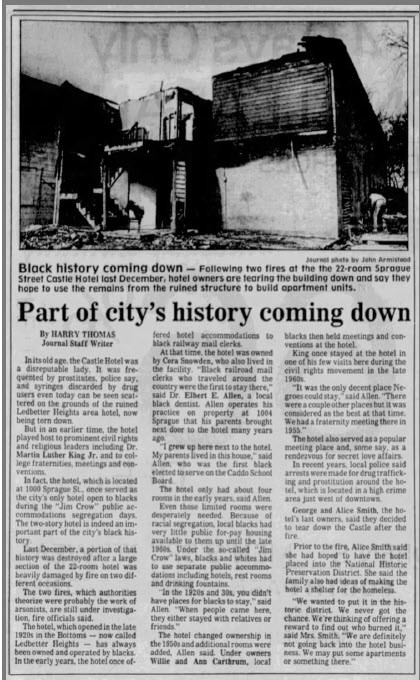
February 28, 1990, page 19.
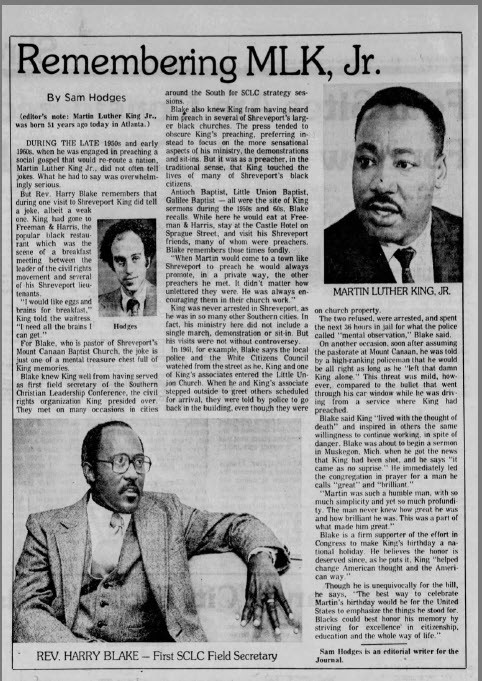
The most enduring legacy of the Castle Hotel is found in an article in the Shreveport Journal in its January 15, 1990 edition. The article featured an interview with Reverend Harry Blake, one of the major figures in the local and national Civil Rights Movement.