
Gary D. Joiner
Summary
In October 1960, the Southern Christian Leadership Conference (SCLC) held its annual conference in Shreveport. Dr. Martin Luther King, Jr. led the group. Dr. C.O. Simpkins of Shreveport was one of Dr. King’s close friends and a fellow Board member. Dr. Simpkins was a significant activist in northwest Louisiana and led the United Christian Movement (UCM) that hosted the SCLC. On October 12, 1960, Shreveport Police stopped a brand new Ford station wagon, harassing Dr. Simpkins. All occupants were arrested. The car had just left Little Union Baptist Church and was en route a short distance to the Sprague Street Hotel, where they stayed. Inside the vehicle was “Dr. Simpkins; Reverend Ralph Abernathy, then president of the Montgomery Improvement Association; Gay Caravan [Guy Carawan] white, a music director; and John Brooks, NAACP Director of Voter Registration.”[1] Dr. Simpkins purchased the vehicle that day. The men were arrested, held for about an hour and a half, and then released. Among the arresting officers was a Louisiana state trooper. “Shreveport Police Chief Harvey D. Teasley denied police took the four men into custody.”[2]
Background Information
That evening, the only white person in the station wagon was Guy Carawan (misspelled in some Shreveport media as Gay Caravan). He was, even then, a significant force in the Civil Rights Movement. Carawan’s major contribution to the Movement was a powerful tool the segregationists could not match or defeat.
Guy Carawan was born in Los Angeles on July 28, 1927. He said of his parents that “He was a poor farm boy, and she was a Charlestonian blue blood.”[3] He graduated from Occidental College with a BS in mathematics in 1949, followed by an MA in sociology from UCLA. Guy Carawan’s passion was music, mainly traditional folk music. His favorite instruments were the guitar and hammer dulcimer. Carawan became friends with Pete Seeger and the folk group The Weavers and moved to New York City, where he became an essential part of the American folk music revival movement. He became the musicologist of the folk song revival and the Civil Rights Movement.
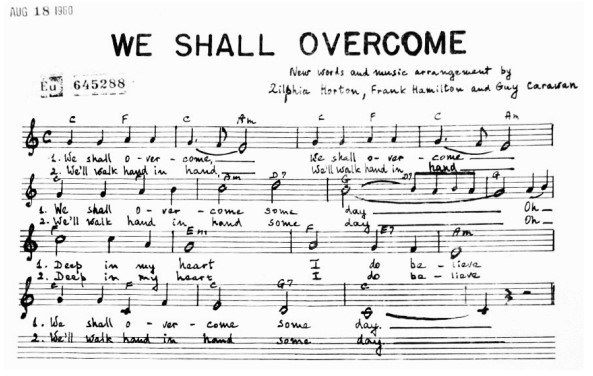
Carawan journeyed to the Highlander Folk School in Monteagle, Tennessee, in 1953. This trip changed the trajectory of his life. He sang, played, and taught with Pete Seeger, Miles Horton, Zilphia Horton, Frank Hamilton, and others several times over the following years. Many of their sessions and collaborations changed popular music forever. Zilphia Horton died in an accident in 1956. Guy met Candie at a Highlander workshop. She attended Fisk University in Nashville as an exchange student from Pomona College in California. Candie was among the first whites in the sit-in movement, a hazardous activity at that time. They traveled throughout the South, helping local activists wherever they were needed. They went to places like Shreveport, accompanied by early luminaries of the Movement. In January 1960, the same year the Carawans came to Shreveport in October, Pete Seeger, Zilphia Horton, Frank Hamilton, and Guy Carawan copyrighted a song “with new words and music arrangement” of an early 1900s Negro spiritual, which became We Shall Overcome. Candie told the Associated Press that that song was often changed before it was copyrighted. Pete Seeger and others worked on it at Highlander.
As Highlander music director, Carawan taught the song to activists who led the sit-in movement of the 1960s. He even sang it at the first organizing meeting of the Student Nonviolent Coordinating Committee on April 15, 1960, said Carawan’s wife, Candie Carawan.
It included a verse added a year earlier by Ethel Dozier, a 13-year-old African American activist. Candie Carawan said Dozier came up with the words “we are not afraid” during a sheriff’s raid on what was then the Highlander Folk School as she, Guy Carawan and others sat in the dark, waiting.[4]
We Shall Overcome has become known as the Ludlow version. Shreveport was among the first places in the nation where this famous version was sung and taught. Little Union Baptist Church was the venue.
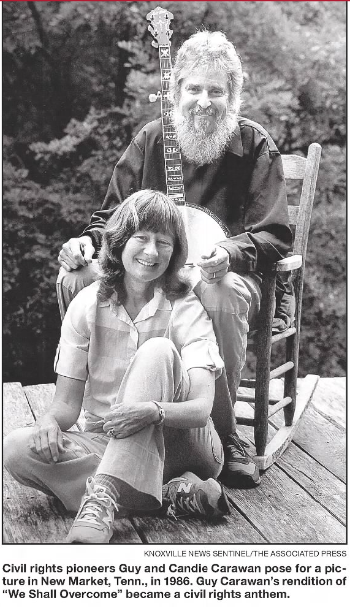
Guy and Candie Carawan were inseparable. Their talents were complementary, and they became famous together. She was twelve years younger. They married on March 17, 1961, in San Berardino, California. He was 33, and she was 21. The founder of the Highlander School and Zilphia’s husband, Myles Horton, asked him to return in 1959 as music director.
[Miles] said Highlander needed a musical director. My job would be to help get people singing and sharing their songs. When someone began to sing, I’d back them up softly on my guitar so they’d get courage and keep going. Sometimes in sharing a song, people find bonds between themselves that they never knew they had. I can’t tell you how many pictures I have of myself standing behind other people, accompanying them on the guitar. I took the job, just for a year–that was thirty years ago.[5]
Candie told the Library of Congress in 2011:
One of Guy’s most important roles during the Civil Rights Movement — more so than introducing “We Shall Overcome” as a Freedom Song — was his desire to record and archive the evolution of the Movement through song. Both Guy and Candie believe that the political usage of religious and folk music could shape movements and influence people to take action in social change, and Guy’s initiative to record and preserve the already established Freedom Songs within the Movement are used to inspire and to educate future leaders and activists.[6]
The Carawans marched with Dr. King in Selma, Alabama. They met and worked with Dr. King, Rosa Parks, and many others at Highlander. Reverend C.T. Vivian of Atlanta, one of Martin Luther King, Jr.’s chief lieutenants, spoke of the power of Guy Carawan’s presence:
I don’t think we had ever thought of spirituals as movement material. When the Movement came up, we couldn’t apply them. The concept has to be there. It wasn’t just to have the music but to take the music out of our past and apply it to the new situation, to change it so it really fit. … The first time I remember any change in our songs was when Guy came down from Highlander. Here he was with this guitar and tall thin frame, leaning forward and patting that foot. I remember James Bevel and I looked across at each other and smiled. Guy had taken this song, “Follow the Drinking Gourd” – I didn’t know the song, but he gave some background on it and boom – that began to make sense. And, little by little, spiritual after spiritual began to appear with new words and changes: “Keep Your Eyes on the Prize, Hold On” or “I’m Going to Sit at the Welcome Table”. Once we had seen it done, we could begin to do it.[7]
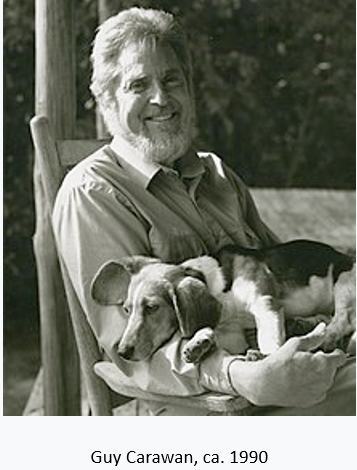
Guy Carawan died, in 2015, at their home in New Market, Tennessee, “after suffering from a form of dementia for years.”[8] Both Guy and Candie had strong, beautiful voices and people quickly picked up on their power and the content of their songs. They recorded several albums over their careers. Among them were:
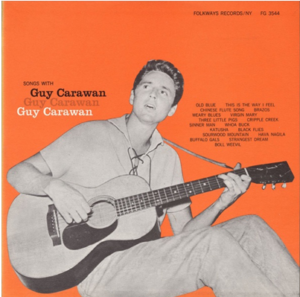
- 1958 Songs With Guy Carawan, Songs With Guy Carawan
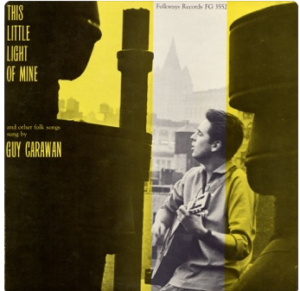
- 1959 This Little Heart of Mine, Guy Carawan
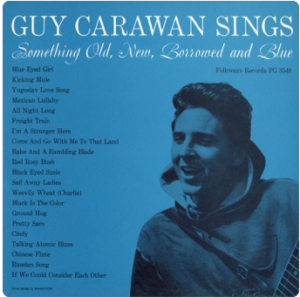
- 1959 Guy Carawan, Vol. 2: Guy Carawan Sings Something Old, New Borrowed and Blue, Guy Carawan
- 1961 We Shall Overcome: Songs of Freedom Riders and Sit-Ins, Guy Carawan, The Montgomery Gospel Trio & The Nashville Quartet
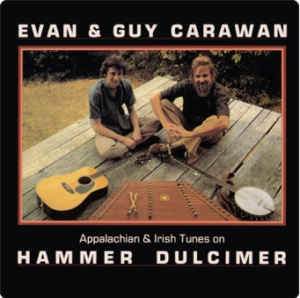
- 1985 Evan & Guy Carawan: Appalachian & Irish Tunes on Hammer Dulcimer, Evan and Guy Carawan
- 1990 Tree of Life (featuring Candie Carawan), Guy and Candie Carawan
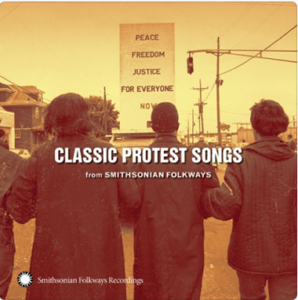
- 2009 Classic Protest Songs, Various Artists
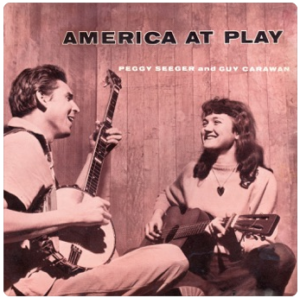
- 2014 America at Play, Peggy Seeger & Guy Carawan
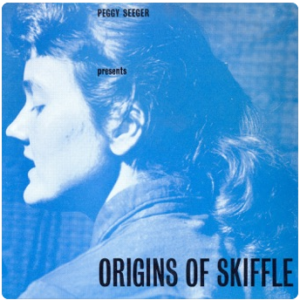
- 2019 Origins of Skittle, Peggy Seeger, Isla Cameron & Guy Carawan
The compendium of the work, recordings, and texts are found in The Guy and Candie Carawan Collection Southern Folklife Collection in the Wilson Library, University of North Carolina at Chapel Hill.
Following Guy Carawan’s death on May 6, 2015, National Public Radio published All Things Considered news. It is found in their archives at:
https://www.npr.org/2015/05/06/404739729/guy-carawan-musician-known-for-we-shall-overcome-dies
Also on this page is a link to a much longer interview from 2013 describing the evolution of We Shall Overcome:
Sources:
Books
- Burton, Willie. On the Black Side of Shreveport: A History. Published by the Author, Shreveport, LA. 1994.
- Carawan, Guy and Candie Carawan.
- We Shall Overcome! New York. Oak Publications. 1963.
- Ain’t You Got a Right to the Tree of Life?: The People of Johns Island South Carolina―Their Faces, Their Words, and Their Songs. Athens, GA. University of Georgia Press. 1966.
- Freedom is a Constant Struggle. New York. Oak Publications. 1968.
- Glen, John M. Highlander: No Ordinary School, 2nd ed. Knoxville, TN. University of Tennessee Press. 1996.
- Seeger, Pete and Bob Reiser, “Everybody Says Freedom: A History of the Civil Rights Movement in Songs and Pictures, including Many Songs Collected by Guy and Candie Carawan,” Yearbook of Traditional Music. Vol. 22: 160. 1990.
Newspapers
- Chillicothe [Ohio] Gazette, May 9, 2015.
- The [Shreveport] Times, October 14, 1960.
- Tulsa [Oklahoma] World, May 9, 2015.
Internet
- Ars Technica — Judge Throws Out 57-year-old Copyright on “We Shall Overcome”
- Guy and Candie Carawan Official Website
- Guy and Candie Carawan Collection, Southern Folklife Collection, UNC Chapel Hill
- Highlander Center official web site
- Library of Congress “Candie Carawan and Guy Hughes Carawan oral history interview conducted by Joseph Mosnier in New Market, Tennessee, 2011 September 19”. www.LOC.gov
- NPR: Guy Carawan, Musician Known for “We Shall Overcome,”–Dies
- https://ondemand.npr.org/anon.npr-mp3/npr/atc/2013/08/20130828_atc_weshall2.mp3?e=404739729&t=progseg&seg=3&sc=siteplayer&aw_0_1st.playerid=siteplayer
- Wikipedia Zilphia_Horton# media File:We_Shall_Overcome
Images
https://arstechnica.com/tech-policy/2017/09/the-most-famous-civil-rights-song-we-shall-overcome-is-no-longer-copyrighted/ https://en.wikipedia.org/wiki/Zilphia_Horton#/media/File:We_Shall_Overcome _-_Ludlow_Version_(1960).png
Wikipedia
Albums
Willie Burton, On the Black Side of Shreveport: A History (Shreveport, LA: Published by the Author, 1994), 97. ↑
Pete Seeger and Bob Reiser, “Everybody Says Freedom: A History of the Civil Rights Movement in Songs and Pictures, including Many Songs Collected by Guy and Candie Carawan,” (Yearbook of Traditional Music, 22: 160, 1990). ↑
“We Shall Overcome” folk singer Guy Carawan dies: Music director at social center was 87,” Chillicothe [Ohio] Gazette, May 9, 2015, Page A2. ↑
““Candie Carawan and Guy Hughes Carawan oral history interview conducted by Joseph Mosnier in New Market, Tennessee, 2011 September 19”. www.LOC.gov ↑
Ibid. ↑
C.T. Vivian interview, 1983, quoted in Sing For Freedom: The Story of the Civil Rights Movement Through Its Songs, Smithsonian Folkways, SF#40032, CD, 1990. A compilation of material from the six LPs. Selected by Guy & Candie Carawan, 1990, p. 4. ↑
“Folk singer, activist Guy Carawan dies,” Tulsa [Oklahoma] World, May 9, 2015, Page 12. ↑