
Mikal Barnes
Summary
Samuel Cooke, popularly known as simply Sam Cooke started his singing career as a Gospel singer. He found relatively quick success switching to more secular music, quickly climbing the charts in the Rhythm and Blues scene. Eventually, when on tour to Shreveport, Louisiana, Cooke had a life-changing experience. Cooke and some friends were turned away from a Holiday Inn hotel in 1963 in Shreveport, Louisiana. Because of this experience, Cooke wrote and performed one of the most iconic songs of the Civil Rights Movement, “A Change is Gonna Come.”
Equipped with one of the most beautiful voices in recent memory, Samuel Cooke, better known as Sam, was born in Clarksdale, Mississippi, but raised in Chicago, Illinois. The son of a Baptist Minister, Charles Cook, he started his singing career as the lead Gospel singer in a group called “Soul Stirrers,” where he wrote and sang several classics.[1] In 1957, Cooke switched to focusing more on Soul and R&B Music.[2] The switch to R&B was successful, as he wrote and sang several songs that became mainstream hits like “Chain Gang,” “Twisting the Night Away,” and Another Saturday Night.” From a brief seven-year run in secular music before his abrupt passing in 1964, he had an astounding thirty American Top 40 hits.[3] Cooke’s success was not limited to the booth, as he became the first African American singer to manage his record label, then known as SAR Records.[4]
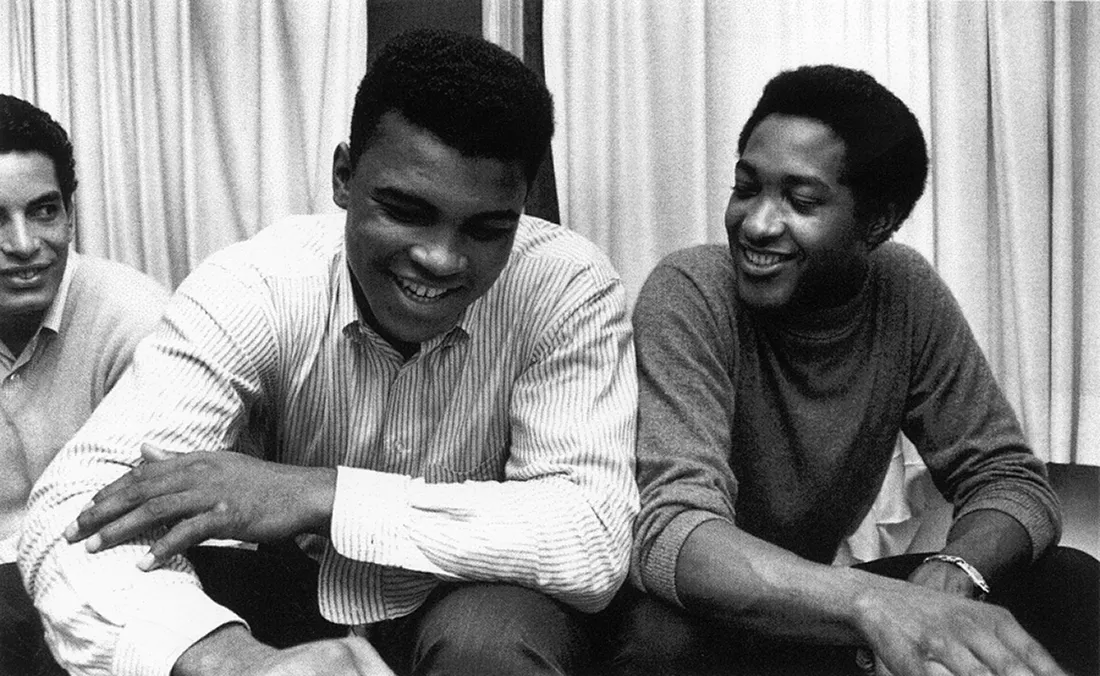
Cooke became more than just a singer; he became a nationally known superstar. He was also friends with several notable icons in their respective areas. He enjoyed a close friendship with Muhammad Ali, then known as Cassius Clay, Jim Brown, an NFL Hall of Famer, and Malcolm X, a revolutionary civil rights icon.[5] Their legendary friendship has been made into the film One Night in Miami, which depicts the night Clay became the World Heavyweight Champion at just 22 years old, following the night the quartet spent celebrating Clay (who announced his conversion to Islam the following day, and ensuing name change) championship against Sonny Liston. The film shows the real-life parallel of when asked to have his close friend Sam Cooke come to the ring when interviewed and claimed that Cooke was “the world’s greatest rock and roll singer.”[6]
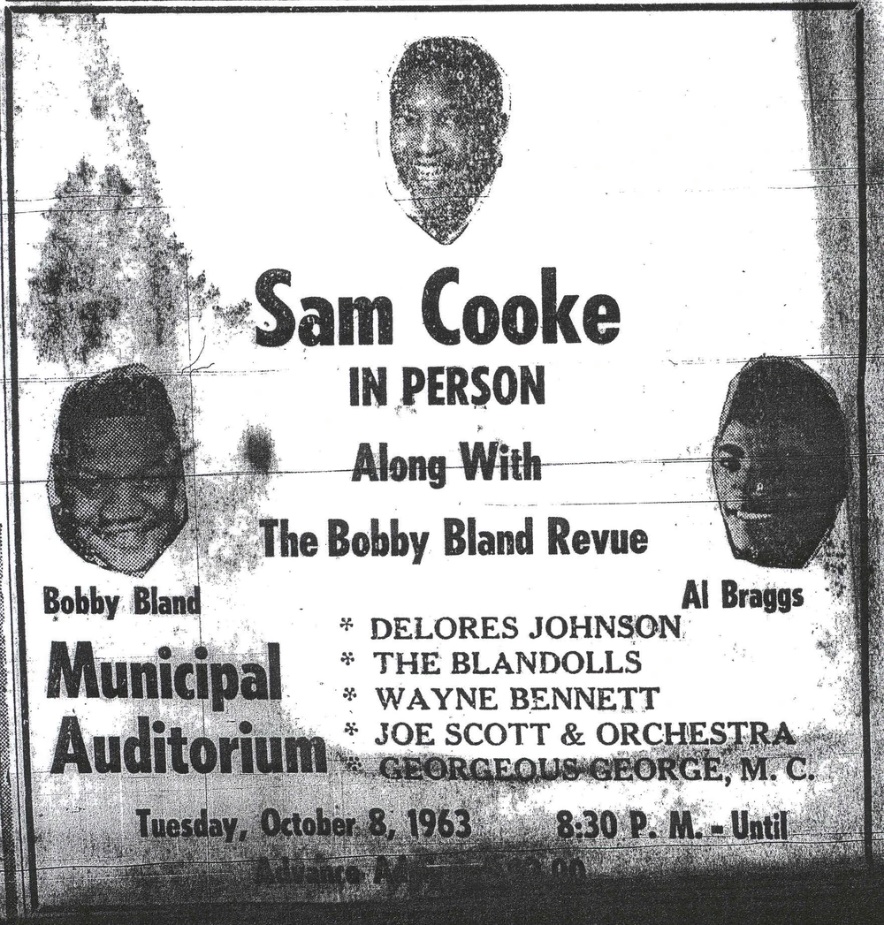
Cooke’s success led him to several avenues throughout the country, and on October 8, 1963, he was set to arrive in Shreveport to perform at the prestigious Municipal Auditorium. Cooke and the “Super Sonic Attractions” went to the Holiday Inn on North Market to settle in before their performance.[7] This is where the trouble began.
Cooke called the Holiday Inn and arranged to stay before his arrival, but the desk clerk turned him around and told him that the hotel had no more empty rooms.[8] This was the common excuse given to many African Americans of the era when being denied service, and there was no exception here. Cooke was denied the room because of his race. Cooke and his brother, Charles Cooke, grew angry instantly. Sam’s wife, Barbara, and his manager were also at the scene. Cook and the others left the hotel, where even more controversy ensued, as reports confirmed a car honking blaring outside the Hotel.[9] However, one of Cooke’s close friends, David Washington, claimed that the car honking resulted from a malfunction with Cooke’s Maserati and was not intentional.[10] The honking led to charges of disturbing the peace for Sam, Charles, Barbara, and Roy Craine, the road manager.[11] The four were arrested at the Castle Hotel, a frequent destination for Black celebrities coming through Shreveport.
Despite their arrest, they made bail after paying the $102.50 bond each, and Cooke was still able to perform at the Municipal Auditorium despite a bomb threat.
This situation rocked Sam Cooke’s consciousness. 1963 proved to be an intense year for racial tensions all around the country. The 16th Street Church Bombing in Birmingham, Alabama, orchestrated by the Ku Klux Klan, the March on Washington for Jobs and Freedom, where Dr. Martin Luther King Jr. gave his renowned “I Have a Dream” speech, to Shreveport’s protest of the 16th Street Church bombing leading to the brutal beating of Rev. Dr. Harry Blake, the unrest was unavoidable, and Cooke was not spared the racism even with his fame.[12] It must be noted that Cooke was no stranger to the overt racism he encountered during his stay in Shreveport, as his previous tours throughout the South were riddled with disturbing incidences. Cooke and another singer, Clyde Mcphatter, refused to perform in Memphis, Tennessee, upon discovering that the audience was segregated and forced to sit in the backside of the hall.[13] With encounters like this frequent throughout the South, it is clear that the Shreveport experience and hearing Bob Dylan’s “Blowin’ in the Wind” were a breaking point and inspired him to write a new song.
Cooke wrote the song “A Change is Gonna Come,” which became a Civil Rights anthem for marginalized groups.[14] According to Cooke’s biographer, the song “It was less work than any song he’d ever written.”[15] Cooke wrote the song within a month of his experience in Shreveport. It’s important to note that the song’s success was not promised; Cooke took a substantial risk by writing a song of this nature, with overt messaging supporting the Civil Rights Movement, risking alienating his white audience. Just as Cooke did not know how the song would be received upon writing it, he did know that, at some point, race relations had to shift. He knew change was imminent despite the many obstacles he and many African Americans endured.
“A Change is Gonna Come” has transcended its time and remains a fixture in popular culture. In 2021, Rolling Stone ranked it number 3 on the list of the 500 Greatest Songs of All Time.[16] In its earliest form, the version played on radio stations did not include the verse alluding to his experience in Shreveport; “I go to the movie, and I go downtown/Somebody keep telling me, don’t hang around.”[17] Unfortunately, Cooke did not live to see its success, as he died in 1964 at 33 years old under mysterious circumstances. Despite his abrupt passing, he has remained a musical icon. He was posthumously inducted into the legendary class of 1986 in the Rock & Roll Hall of Fame, next to James Brown, Elvis Presley, Little Richard, Fats Domino, Ray Charles, Chuck Berry, and several other genre icons.[18] In 1999, Cooke was gifted the Lifetime Achievement Grammy Award.[19] The song has been covered and sampled more than 500 times since its release by notable artists such as Beyoncé, Arthea Franklin, Al Green, Otis Redding, and many other legends.
Fifty-six years later, after the Holiday Inn incident, then-Shreveport Mayor Adrian Perkins apologized on behalf of the city for Cooke’s treatment. Perkins said the apology was in order: “I am issuing this apology for two reasons: First, the Cooke family deserves it. Second, because Sam Cooke’s legacy reminds us that change comes when people take action.”[20] Cooke decided to use his voice to take a stand against injustice, and despite his passing, his legend will live on through one of the most influential songs in American history. Even though dreary circumstances caused Cooke to write “A Change is Gonna Come,” it should still be celebrated for its timeless message of being a positive advocate of change in the face of seemingly insurmountable challenges.
Photos:
Source of this Photo – https://www.explorelouisiana.com/music/sam-cooke-holiday-inn-north
Videos:
Sam Cooke and Muhammad Ali Singing together:
Muhammad Ali invites Sam Cooke to the ring:
Works Cited
- C. McCauley Ricketts. “Muhammad Ali Sam Cooke,” June 4, 2016. https://www.youtube.com/watch?v=rvHU-gZY7Vg.
- Chaney, Aofie. “The Silencing of a Black Friendship: Muhammad Ali, Sam Cooke, Malcolm X & Jim Brown.” Medium, March 30, 2022. https://aoifechaney.medium.com/the-silencing-of-a-black-friendship-muhammad-ali-sam-cooke-malcolm-x-jim-brown-16ef4de0ac4d#:~:text=The%20friendship%20of%20Muhammad%20Ali,limitations%20of%20a%20segregated%20America.
- Freeland, David. “Behind the Song: Sam Cooke, “A Change Is Gonna Come” American Songwriter, December 2, 2019. https://americansongwriter.com/sam-cooke-behind-the-song-a-change-is-gonna-come/.
- Newspapers.com. “Oct 09, 1963, Page 27 – the Shreveport Journal at Newspapers.com,” n.d. https://www.newspapers.com/image/601342600/?terms=Sam%20Cooke&match=1.
- Ritz, David. “Sounds of the 60s With Tony Blackburn – Sam Cooke,” July 12, 2014. https://www.bbc.co.uk/programmes/articles/pMCt55SRKljqcqnJLhlgFR/sam-cooke.
- “Sam Cooke | Biography, Music, & Facts.” Encyclopedia Britannica, March 25, 2024. https://www.britannica.com/biography/Sam-Cooke.
- “Sam Cooke | Rock & Roll Hall of Fame,” n.d. https://www.rockhall.com/inductees/sam-cooke.
- “Sam Cooke Songwriters Hall of Fame,” 1931. https://www.songhall.org/profile/Sam_Cooke.
- Shank, Barry. “Sam Cooke and the Power and Limits of the Pop Anthem.” Slate Magazine, October 18, 2016. https://slate.com/culture/2016/10/sam-cookes-a-change-is-gonna-come-is-a-civil-rights-anthem.html.
- Skiles, Blane. “How Shreveport’s Complicated Past Inspired Sam Cooke to Write ‘A Change Is Gonna Come.’” KSLA. June 22, 2019. https://www.ksla.com/2019/06/22/how-shreveports-complicated-past-inspired-sam-cooke-write-change-is-gonna-come/.
- Spigner, Clarence. “Sam Cooke (1931-1964),” Blackpast. December 31, 2023. https://www.blackpast.org/african-american-history/cooke-sam-1931-1964/.
- Staff, NPR. “Sam Cooke and the Song That ‘Almost Scared Him.’” NPR, February 1, 2014. https://www.npr.org/2014/02/01/268995033/sam-cooke-and-the-song-that-almost-scared-him.
- Stanley, Bob. “Sounds of the 60s With Tony Blackburn – Sam Cooke,” BBC. July 12, 2014. https://www.bbc.co.uk/programmes/articles/pMCt55SRKljqcqnJLhlgFR/sam-cooke.
- Wirt, John. “‘A Change Is Gonna Come’ – 64 Parishes,” 64 Parishes. December 11, 2023. https://64parishes.org/entry/a-change-is-gonna-come.
- Zdanowicz, Sophie Sherry, Christina. 2019. “Sam Cooke Was Turned Away from a Louisiana Hotel in 1963. Now a Local Mayor Is Apologizing.” CNN. June 24, 2019. https://www.cnn.com/2019/06/24/us/louisiana-apologies-sam-cooke-mistreatment-trnd/index.html.
Endnotes
“Sam Cooke | Songwriters Hall of Fame.” n.d. Www.songhall.org. https://www.songhall.org/profile/Sam_Cooke. ↑
David Ritz. “Sam Cooke.” Encyclopedia Britannica, March 25, 2024. https://www.britannica.com/biography/Sam-Cooke. ↑
BBC, “Sounds of the 60s With Tony Blackburn – Sam Cooke,” July 12, 2014, https://www.bbc.co.uk/programmes/articles/pMCt55SRKljqcqnJLhlgFR/sam-cooke. ↑
Clarence Springer, 2007, “Sam Cooke (1931-1964).” February 25, 2007. https://www.blackpast.org/african-american-history/cooke-sam-1931-1964/. ↑
Aoife Chaney, “The Silencing of a Black Friendship: Muhammad Ali, Sam Cooke, Malcolm X & Jim Brown,” Medium, March 30, 2022, https://aoifechaney.medium.com/the-silencing-of-a-black-friendship-muhammad-ali-sam-cooke-malcolm-x-jim-brown-16ef4de0ac4d#:~:text=The%20friendship%20of%20Muhammad%20Ali,limitations%20of%20a%20segregated%20America. ↑
C. McCauley Ricketts, “Muhammad Ali Sam Cooke,” June 4, 2016, https://www.youtube.com/watch?v=rvHU-gZY7Vg. ↑
“Negro Singer Arrested Here: Vocalists’ Touring Group Charged with Disturbing Peace,” The Shreveport Journal, October 9, 1963, page 27. ↑
John Wirt, “A Change Is Gonna Come,” 64 Parishes, September 27, 2023, https://64parishes.org/entry/a-change-is-gonna-come ↑
Ibid. ↑
Sophie Sherry and Christina Zdanowicz, “Sam Cooke Was Turned Away from a Louisiana Hotel in 1963. Now a Local Mayor Is Apologizing.” CNN. June 24, 2019. https://www.cnn.com/2019/06/24/us/louisiana-apologies-sam-cooke-mistreatment-trnd/index.html. ↑
The Shreveport Journal, “Negro Singer Arrested Here,” October 9, 1963. ↑
Blaine Skiles, “How Shreveport’s complicated past inspired Sam Cooke to write ‘A Change is Gonna Come,’” KSLA, June 22, 2019. https://www.ksla.com/2019/06/22/how-shreveports-complicated-past-inspired-sam-cooke-write-change-is-gonna-come/ ↑
Barry Shank, “Sam Cooke and the Power and Limits of the Pop Anthem,” Slate Magazine, October 18, 2016, https://slate.com/culture/2016/10/sam-cookes-a-change-is-gonna-come-is-a-civil-rights-anthem.html. ↑
John Wirt, “A Change Is Gonna Come,” 64 Parishes, September 27, 2023, https://64parishes.org/entry/a-change-is-gonna-come ↑
NPR Staff, “Sam Cooke and the Song that “Almost Scared Him’” NPR, February 1, 2014. https://www.npr.org/2014/02/01/268995033/sam-cooke-and-the-song-that-almost-scared-him ↑
John Wirt, “A Change Is Gonna Come,” 64 Parishes, September 27, 2023. https://64parishes.org/entry/a-change-is-gonna-come ↑
David Freeland, “Behind the Song: Sam Cooke, “A Change Is Gonna Come,” American Songwriter, 2019. https://americansongwriter.com/sam-cooke-behind-the-song-a-change-is-gonna-come/ ↑
“Sam Cooke | Rock & Roll Hall of Fame,” n.d., https://www.rockhall.com/inductees/sam-cooke. ↑
David Ritz, “Sam Cooke | Biography, Music, & Facts,” Encyclopedia Britannica, March 25, 2024, https://www.britannica.com/biography/Sam-Cooke. ↑
Blaine Skiles, “How Shreveport’s complicated past inspired Sam Cooke to write ‘A Change is Gonna Come,’” KSLA, June 22, 2019. https://www.ksla.com/2019/06/22/how-shreveports-complicated-past-inspired-sam-cooke-write-change-is-gonna-come/ ↑